Join this online
SUMMER
FREE COURSE:
Build Manufacturing Excellence with AIAG Core Quality Tools
When: Every Wednesday in July and August
Where: exclusively in your mailbox
Language: English
Limited spots!!!
What you will learn?
This comprehensive course provides a detailed understanding of AIAG Core Tools as mandatory tools in quality management in the automotive industry. Whether you are an industry professional, a student, or simply interested in gaining knowledge in this field, this course will equip you with essential insights and practical skills.
See details below of each VIDEO LESSON you will exclusively get on your mailbox every week!

Advanced Product Quality Planning (APQP):
Delve into the APQP process, which ensures that products are developed per customer requirements and specifications. Understand each stage of APQP, from planning to production, and how it helps streamline product development and prevent potential failures.

Control Plan (CP):
This lesson covers the creation and implementation of control plans, which define the critical characteristics and processes that must be monitored to maintain consistent quality. Learn how to develop effective control plans to prevent defects and ensure continuous improvement.

Measurement System Analysis (MSA) – Attribute Values:
We will focus on MSA for attribute values, which is critical for evaluating the consistency and accuracy of measurement systems. Learn how to assess measurement systems that deal with attribute data (pass/fail, go/no-go) and ensure reliable data for decision-making.

Measurement System Analysis (MSA) – Variable Values:
This lesson covers MSA for variable values, which involve continuous data measurements (such as weight, length, and temperature). Understand how to analyze and evaluate the effectiveness of measurement systems used to collect variable data, ensuring that your measurements are precise and accurate.

Statistical Process Control (SPC) for Control Charts:
This module focuses on control charts, which are essential tools for monitoring and controlling process stability. Learn how to use control charts to track process behavior over time, identify any signs of variation, and take corrective actions to maintain consistent quality.

Statistical Process Control (SPC) – Process Capability:
Explore the concept of process capability, which assesses how well a process can meet specified limits. Learn how to calculate and interpret process capability indices (Pp, Ppk/Cp, Cpk) to evaluate whether your processes are capable of producing products within required specifications.
Failure Modes and Effects Analysis (FMEA):
Learn how to systematically evaluate potential risks and failures in both design and process using FMEA. This lesson covers the methodology of identifying, analyzing, and prioritizing risks to implement effective corrective actions, ultimately preventing product failures.
Production Part Approval Process (PPAP):
Learn about the PPAP process, which validates a supplier’s ability to produce products that meet specifications and quality standards. Understand the key components of PPAP, including documentation requirements and how it ensures parts are capable of being manufactured in series production.
Integrating Core Quality Tools for Quality Management:
How to integrate and apply the core tools (APQP, CP, PPAP, MSA, SPC, FMEA) to create a cohesive quality management system. Understand how these tools work together to enhance product development, streamline processes, and mitigate risks.
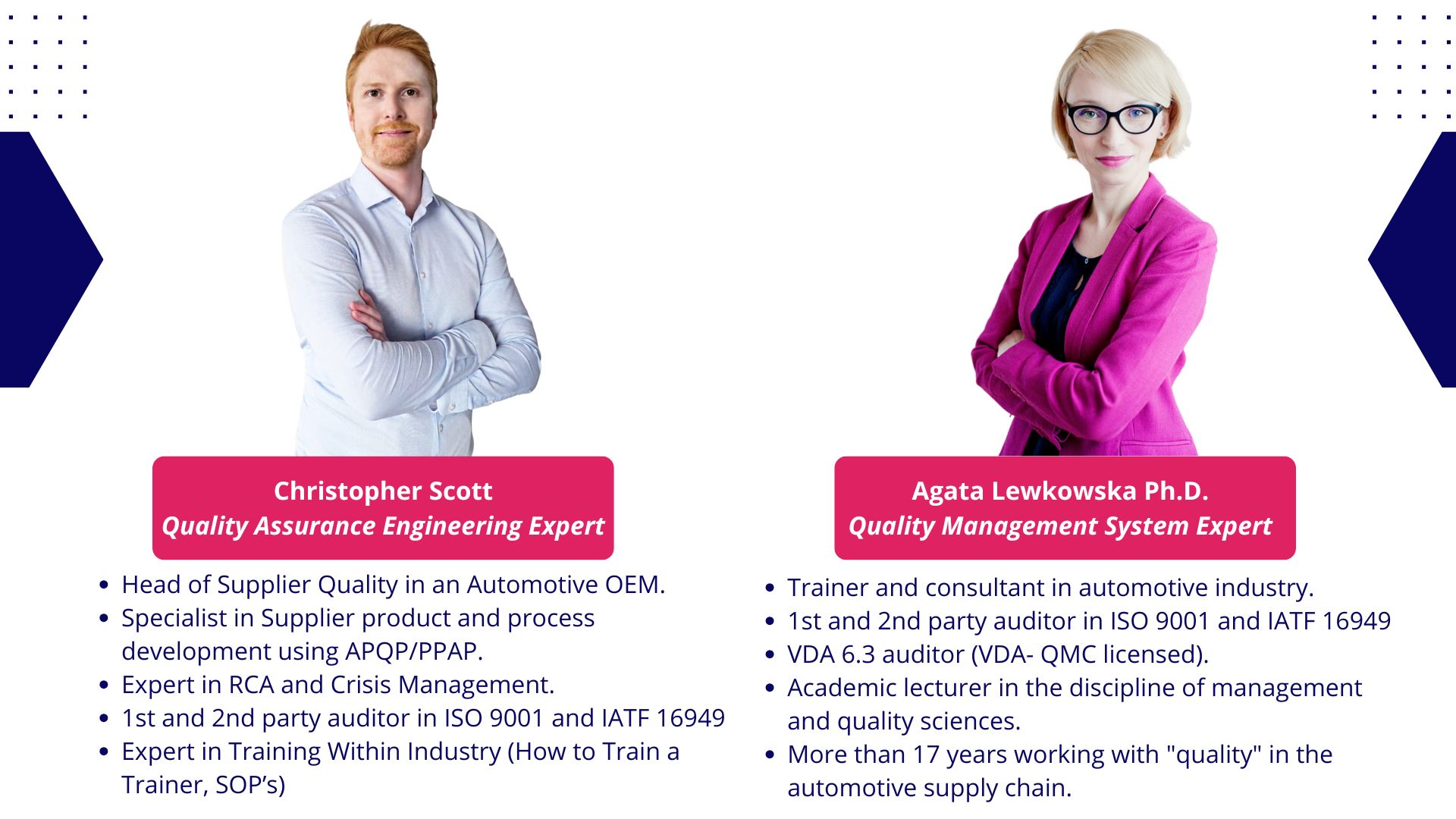
Who created this course?
6 Reasons/Problem Examples We Will Help You Solve:
Streamlining Product Launches with APQP:
Learn how to use APQP to ensure your product is launched on time and meets customer and internal requirements, reducing costly delays and failures.
Maintaining Consistent Quality with Control Plans:
Master the creation of Control Plans that ensure continuous quality in production processes, preventing defects before they occur.
Ensuring Supplier Quality with PPAP:
Learn how to use PPAP to qualify suppliers and ensure that incoming materials and parts meet all specifications before production begins.
Ensuring Accurate Measurements with MSA:
Understand how to perform Measurement System Analysis to ensure that the data you are working with is accurate and reliable.
Improving Process Stability with SPC:
Gain the skills to implement control charts to monitor process capability and make real-time adjustments to prevent defects.
Mitigating Risks Early with FMEA:
Learn to identify and mitigate risks in your design and manufacturing processes using FMEA, reducing the likelihood of failures and costly rework.

Are You on this list below?
Who shall participate in
a course:
- Industry Professionals involved in automotive manufacturing or service sectors can benefit from this course. It provides them with the knowledge and skills necessary to excel in their roles and contribute to the overall quality management efforts within their organizations.
- Automotive Engineers can greatly benefit from this course. It offers them insights into quality management principles and practices specifically tailored to the automotive sector, enabling them to optimize processes and ensure the production of high-quality vehicles and components.
- Supplier Quality Professionals involved in managing supplier quality and conducting supplier audits in the automotive industry can enhance their skills through this course. It provides them with a comprehensive understanding of the quality management requirements, enabling them to establish robust supplier quality management processes and drive continuous improvement throughout the supply chain.
- Internal or Supplier Auditors will gain a deeper understanding of the expectations and requirements that organizations must meet to comply with these standards.
- Anyone Interested in Automotive Quality Management:
Whether you are an industry professional, a student, or someone interested in quality management in the automotive industry, this course offers valuable insights and practical skills to help you excel in your career or expand your knowledge in this specialized field.

Do you still hesitate?
What do you receive?
Starting on the 1st of July you will receive the following 9 weeks an email with your video lesson.
Yes, I am interested in this FREE COURSE:
Build Manufacturing Excellence with AIAG Core Quality Tools